

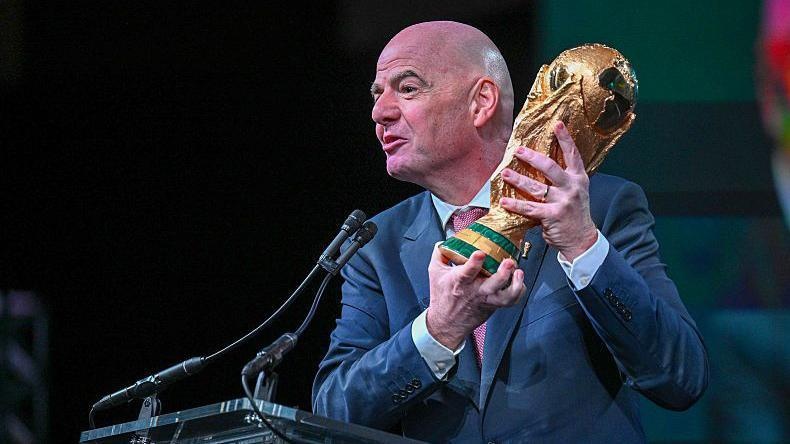
Football is supposed to be decided by skill, courage and performance—not by political pressure, inconsistent disciplinary rulings or decisions made behind closed doors.
Yet, as controversy continues to surround the 2026 FIFA World Cup, FIFA President Gianni Infantino can no longer afford to behave like a ceremonial guest moving from one stadium to another. The time has come for him to demonstrate firm leadership, crack the whip and restore confidence in the organisation he leads.
FIFA is responsible for protecting the credibility of the world’s most popular sport. Its president represents the organisation, chairs its highest governing bodies and helps coordinate its overall strategic direction. That position must therefore carry more than prestige, photographs and speeches. It must come with visible accountability.
The Controversies Are Becoming Too Loud to Ignore
The latest tournament has produced complaints about refereeing, VAR decisions, disciplinary procedures and possible outside influence.
Egypt’s football authorities formally criticised the officiating and use of VAR following their dramatic World Cup defeat to Argentina. Several former players and analysts also questioned the consistency of key decisions during the match. FIFA had not publicly responded to the complaint at the time of reporting.
Elsewhere, FIFA faced fierce criticism after the suspension attached to Folarin Balogun’s red card was lifted. UEFA described the decision as unprecedented and unjustifiable, while Belgium challenged the ruling before its match against the United States. Reports also raised questions about whether political intervention played a role, although FIFA maintained that its disciplinary process acted independently.
Whether every accusation is ultimately proven is not the only issue. The deeper problem is the growing perception that FIFA’s rules may not be applied equally to everyone.
Once supporters begin to believe that powerful countries, famous players or politically connected individuals receive special treatment, the integrity of the entire competition comes under threat.
Infantino Must Defend Referees but Also Demand Excellence
Referees should never be subjected to intimidation, abuse or political attacks. FIFA was right to publicly support Brazilian referee Raphael Claus after he was personally criticised over a World Cup decision. Match officials must be protected from threats and unfair character assassination.
However, defending referees must not mean protecting poor performances from legitimate scrutiny.
When an official makes a serious error, FIFA should acknowledge it. When VAR produces a questionable intervention, the reasoning should be clearly explained. When a referee repeatedly falls below the required standard, that official should be removed from future matches.
Accountability is not an attack on referees. It is how standards are maintained.
Infantino must demand that FIFA’s Referees Committee communicates more openly with teams and supporters. Releasing brief explanations for major VAR decisions would help reduce suspicion and misinformation.
Silence creates conspiracy theories. Transparency builds trust.
One Rule Must Apply to Every Nation
FIFA cannot preach fairness while appearing to bend its own disciplinary rules whenever an influential person complains.
A red card shown to a player from a smaller football nation must carry the same consequences as a red card shown to a star representing a major commercial market. There cannot be one disciplinary system for powerful countries and another for everyone else.
The integrity of a tournament is destroyed when punishments appear negotiable.
Infantino must instruct FIFA’s disciplinary bodies to publish clearer explanations whenever a suspension is overturned, reduced or delayed. The evidence, legal justification and relevant regulations should be made available without unnecessary secrecy.
FIFA lists its disciplinary, ethics and appeal bodies as independent committees. Those institutions must be allowed to work without pressure from politicians, sponsors, host governments or senior football executives.
Political Interference Must Be Confronted Immediately
Football and politics will always cross paths, especially during a global tournament involving national teams and governments. However, there must be a clear boundary between diplomatic involvement and interference in sporting decisions.
Infantino must send an unmistakable message that FIFA’s decisions cannot be changed through private phone calls or political pressure. Any attempt to influence sporting or disciplinary matters should be documented, investigated and publicly addressed.
The FIFA president’s relationships with world leaders may help secure tournaments, visas, infrastructure and commercial agreements. But those relationships must never compromise competitive fairness.
Racism and Discrimination Require More Than Statements
FIFA has also investigated an alleged racist incident involving popular streamer IShowSpeed during the World Cup. The organisation condemned discrimination and said it had opened an investigation.
Investigations are necessary, but football has heard enough carefully prepared statements.
There must be meaningful consequences.
Supporters found guilty of racist abuse should face lengthy stadium bans. Member associations that repeatedly fail to control discriminatory behaviour should receive serious sanctions. Players, officials and media workers must know that FIFA’s anti-racism campaigns are backed by action.
A slogan displayed before kickoff means little when offenders return to the stands the following week.
FIFA Must Stop Allowing Suspicion to Overshadow the Football
The 2026 World Cup should be remembered for extraordinary goals, emerging stars and unforgettable matches. Instead, too many conversations are becoming dominated by referees, VAR, disciplinary reversals and political influence.
That is a leadership failure.
Infantino may not personally make every refereeing or disciplinary decision, but as FIFA president, he carries responsibility for the culture, direction and public credibility of the organisation.
He must stop appearing merely as the smiling face of the tournament and start acting like the guardian of the game.
That means demanding accountability from referees, protecting independent disciplinary bodies, confronting political interference and ensuring that the same regulations apply to every team.
It also means admitting mistakes when FIFA gets something wrong.
Football supporters are not asking for perfection. They understand that referees are human and that difficult decisions will always produce debate.
What they are demanding is consistency, honesty and fairness.
The Whip Must Start Cracking Now
Gianni Infantino has an opportunity to prove that FIFA is stronger than political pressure, commercial influence and personal relationships.
He must act before distrust becomes permanent.
Those who fail to meet officiating standards must be removed. Officials who abuse their positions must be sanctioned. Political figures who attempt to interfere must be firmly rejected. Disciplinary decisions must be explained transparently, and every participating nation must be treated equally.
FIFA cannot continue asking supporters to trust the process while refusing to fully explain the process.
The world is watching, and the patience of football fans is running out.
Mr. Infantino, the time for diplomatic smiles is over.
It is time to crack the whip—or risk presiding over a game whose credibility has been damaged beyond repair.
