
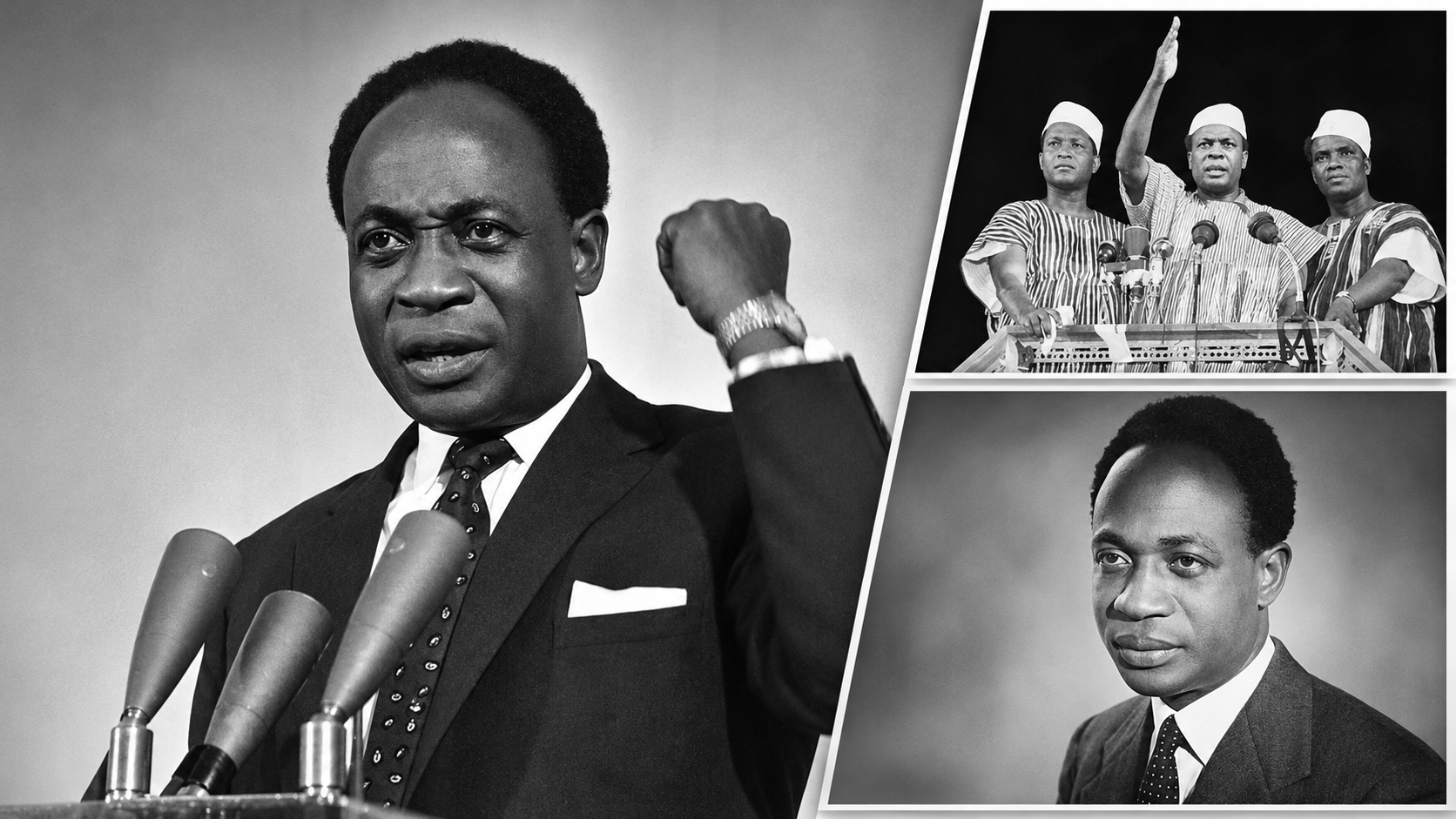
Nearly seven decades after Ghana made history as the first sub-Saharan African colony to gain independence from British colonial rule, a controversial question continues to challenge the nation’s historical identity: Have Ghanaians been told the complete truth about the struggle for independence, or has political influence distorted the contributions of those who fought for freedom?
On March 6, 1957, Ghana’s independence became a defining moment in African history. Dr. Kwame Nkrumah emerged as the face of that victory, inspiring generations with his vision of African liberation.
However, behind the celebrations, national monuments, history books, and political speeches lies a much broader story involving numerous personalities whose sacrifices deserve recognition.
Was Independence the Achievement of One Man?
For decades, discussions surrounding Ghana’s independence have often revolved around Nkrumah and the legendary Big Six.
Nkrumah’s contribution remains undeniable. His leadership of the Convention People’s Party (CPP), mass political mobilization, and demand for immediate self-government helped accelerate the country’s transition from colonial rule.
Yet Ghana’s independence movement did not begin with Nkrumah, nor was it accomplished by him alone.
Political figures including Dr. J.B. Danquah, Paa Grant, Edward Akufo-Addo, Emmanuel Obetsebi-Lamptey, William Ofori-Atta, and Ebenezer Ako-Adjei contributed to the nationalist struggle in different capacities.
The formation of the United Gold Coast Convention (UGCC) in 1947 created an important platform for organized political opposition to colonial rule.
Nkrumah later broke away to establish the CPP in 1949, introducing a more radical approach that transformed the independence campaign into a mass political movement.
The Forgotten Heroes of Ghana’s Freedom
Beyond prominent politicians, countless ordinary citizens contributed to the struggle.
Market women, farmers, workers, traditional leaders, youth activists, and ex-servicemen challenged colonial injustices through protests, political mobilization, and economic resistance.
The February 28, 1948, shooting of three ex-servicemen during a protest in Accra became a major turning point, triggering widespread unrest and intensifying demands for political change.
Women traders also played important roles in economic boycotts and nationalist organizing, although historians have highlighted how their contributions have frequently received limited recognition.
Their stories raise an uncomfortable question: Why do a few celebrated personalities dominate the national narrative while thousands of ordinary freedom fighters remain largely forgotten?
Has Politics Rewritten Ghana’s History?
One major concern is how Ghana’s political divisions have influenced the interpretation of independence.
Supporters of Nkrumah frequently emphasize his revolutionary leadership, while admirers of the Danquah-Busia political tradition highlight the contributions of earlier nationalists and constitutional reformers.
These competing interpretations risk turning a collective national achievement into a political contest over historical ownership.
However, differences in historical interpretation do not automatically establish that the record was deliberately falsified.
The danger arises when political loyalty determines which contributions are celebrated, minimized, or excluded.
Ghana Deserves the Complete Story
Ghana’s independence was not simply the achievement of one political party, one ideology, or one extraordinary individual.
It resulted from years of resistance, political organization, sacrifice, negotiation, and collective determination.
The responsibility now falls on historians, educators, political leaders, and national institutions to present a balanced account supported by credible historical evidence.
Recognizing Nkrumah’s extraordinary leadership should never require erasing the contributions of others. Equally, celebrating other nationalists should not diminish Nkrumah’s defining role.
Ghana’s history belongs to its people, not political parties.
The real question is no longer merely who won independence, but whether future generations will inherit the complete story of how freedom was achieved.
And until every deserving voice receives its rightful place in that history, the debate over Ghana’s true independence story will remain unfinished.