
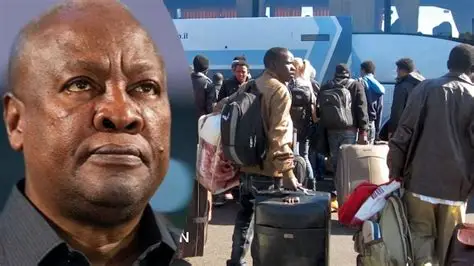
Ghana has come under intense international scrutiny following a shocking investigation by CBS News’ 60 Minutes, which revealed allegations that Ghanaian authorities forcibly returned migrants deported from the United States to countries where American immigration judges had previously ruled they could face persecution or torture.
The investigation, aired on October 25, 2026, uncovered the identities of 63 individuals aboard a deportation flight that departed Texas on July 30, making stops in Sierra Leone, the Central African Republic and Ghana.
According to 60 Minutes, journalists successfully contacted 19 individuals who had been sent to Ghana. Astonishingly, 17 claimed Ghanaian authorities subsequently transported them against their will to their countries of origin, despite existing U.S. immigration court protections.
The countries reportedly included Mali, Niger, Nigeria, Guinea and The Gambia.
One particularly disturbing account involved Moussa Diawara, a Malian national who had established a family life in Texas.
Diawara claimed he was transported to Ghana, detained under armed security and denied communication with his family and legal representatives.
Within days, he alleged, Ghanaian authorities forced him onto another flight to Mali, despite an American immigration judge previously granting him protection against deportation to that country.
Diawara later described living in hiding and fearing for his safety after arriving in Mali without money or identification.
Here’s what 60 minutes left on the cutting room floor, some of the most dangerous and violent criminals we’ve removed to third countries:
— U.S. Immigration and Customs Enforcement (@ICEgov) October 26, 2026
The investigation raises serious questions about whether third-country deportation arrangements are being used to circumvent legal protections issued by U.S. immigration courts.
Under American immigration law, individuals granted withholding of removal cannot legally be deported by the United States to countries where they are more likely than not to face persecution.
However, the Trump administration has defended its third-country deportation policy, arguing that it strengthens immigration enforcement and protects American communities.
James Percival, a senior attorney with the U.S. Department of Homeland Security, told 60 Minutes that he was unaware of cases involving Ghana forcibly returning protected deportees to their home countries.
He also suggested that some individuals might have voluntarily agreed to return or that receiving countries could have acted under their own immigration procedures.
Meanwhile, the investigation found that only 19% of passengers on the identified flight had criminal charges or convictions beyond traffic offenses.
Ghana’s government declined to comment to the programme.
The revelations have intensified concerns about human rights, international immigration agreements and the responsibilities of governments receiving deportees.
The biggest unanswered question remains whether Ghana’s role in America’s deportation programme is exposing vulnerable migrants to the very dangers U.S. courts sought to protect them from.