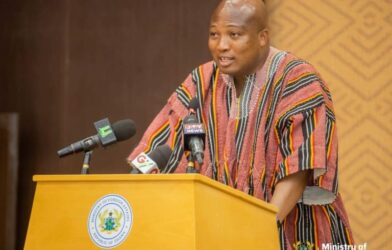


Education should be a tool for unlocking intellectual potential rather than a system that unnecessarily limits academic advancement. The position taken by Ghana’s Minister of Education, Haruna Iddrisu, against allowing students below Junior High School Form Three (JHS 3) to sit the Basic Education Certificate Examination (BECE) raises important questions about educational flexibility, academic excellence and individual learning abilities.
While the government’s intention to protect educational standards deserves consideration, a blanket restriction could disadvantage exceptionally gifted students capable of progressing beyond their current academic level.
Is a two-year ban the right solution?
Speaking at the opening of the 2026 National Education Week on Monday, November 23, Education Minister Haruna Iddrisu directed the Ghana Education Service (GES) to impose a two-year examination ban on JHS 1 and JHS 2 pupils who attempt to write the BECE prematurely.
The minister explained that the measure was intended to promote discipline, prevent irregular academic progression and improve educational planning.
Under existing West African Examinations Council (WAEC) regulations, school candidates must be in their third year of JHS to qualify for the examination. Therefore, the eligibility restriction itself is not new; the two-year punishment is the major issue that deserves scrutiny.
However, should a child lose two academic years because of an attempt to advance academically, particularly when parents and school authorities may have facilitated the registration?
Academic excellence should not be suppressed
Not every student learns at the same pace. While some require additional time to understand academic concepts, others demonstrate exceptional abilities that enable them to master subjects ahead of their peers.
Research published in the Review of Educational Research has established that appropriately implemented academic acceleration can improve educational outcomes for gifted students. A separate 35-year longitudinal study found no evidence that carefully managed academic acceleration compromised their long-term psychological well-being.
Ghana should consider these findings when developing policies that determine how academically gifted children progress through school.
Rather than completely shutting the door on accelerated education, the ministry should explore mechanisms that identify exceptional students and provide them with appropriate opportunities.
Why punish children for the decisions of adults?
Another troubling aspect of the directive is that children could bear the consequences of decisions made by their parents and school administrators.
If school authorities knowingly register ineligible candidates, accountability should primarily rest with those responsible for facilitating the irregularity.
A two-year suspension could disrupt a child’s education, undermine their confidence and impose additional financial burdens on families.
Ghana needs educational flexibility, not rigid restrictions
Instead of imposing a blanket punishment, the Ministry of Education should consider introducing an approved academic acceleration programme involving competency examinations, independent assessments, psychological readiness evaluations and verification of curriculum completion.
Such a framework would distinguish genuinely exceptional students from those being pressured by ambitious parents to advance prematurely.
It would also preserve examination integrity without denying deserving students opportunities to fulfil their potential.
Ghana must protect educational standards, but discipline should not come at the expense of intellectual development.
Haruna Iddrisu’s directive may address examination irregularities, but its punitive approach deserves reconsideration.
A progressive educational system should measure children by their demonstrated knowledge, competence and readiness, rather than simply the number of years they have spent in a classroom. Ghana must regulate academic advancement, not criminalise ambition.