

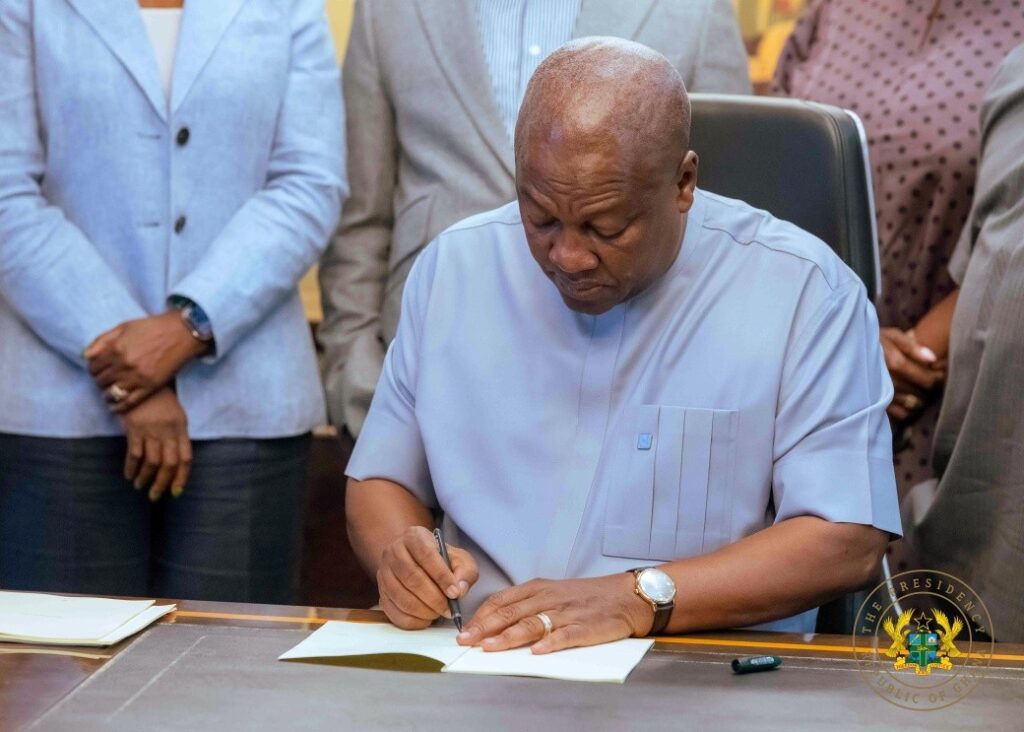
President John Dramani Mahama has signed 10 major bills into law, ushering in sweeping changes across Ghana’s taxation, cocoa, customs, energy, justice and national security sectors.
The presidential assent, announced on Wednesday, August 26, 2026, completes the legislative process after Parliament approved the measures during its recent sittings.
Among the newly approved laws are the Value Added Tax (Amendment) Bill, Income Tax (Amendment) Bill, Customs Bill, Excise Bill, Ghana Cocoa Board Bill and Energy Sector Levies (Amendment) Bill.
The remaining legislation includes the Community Service Bill, Tribunals Bill, Maritime and Related Offences Bill and National Defence University Bill.
The development is expected to have significant implications for businesses, workers, farmers, importers and Ghana’s wider economy.
Under the new Income Tax amendment, minimum-wage earners will be exempt from income tax, while the turnover threshold under the presumptive tax system has been increased from GH¢200,000 to GH¢750,000.
The new Cocoa Board law also introduces major changes for Ghana’s cocoa industry. Cocoa farmers are to receive at least 70% of the gross Free-on-Board price, while at least 50% of Ghana’s cocoa beans are expected to be processed locally. Cocoa farms will also receive protected-land status as part of measures aimed at safeguarding the industry.
Meanwhile, the Customs law introduces tighter controls on bonded warehouses and customs administration, including new warehousing limits and electronic inventory systems linked to Customs.
The Community Service law creates an alternative to imprisonment for certain minor offences, allowing courts to impose supervised community work instead of custodial sentences in qualifying cases.
The Excise law also removes excise duty on locally manufactured fruit juices while restructuring the taxation of some alcoholic products.
President Mahama’s signing of the 10 bills marks another major legislative move by his administration as it pushes reforms across Ghana’s economy and public institutions.
With the laws now formally enacted, attention will turn to their implementation and the impact they will have on taxpayers, businesses, cocoa farmers and ordinary Ghanaians.